How to Verify Businesses with a Free Company Search Directory

Before we dive into the data, let’s clarify why business verification has transitioned from a back-office administrative task to a front-line strategic advantage for UK SMEs. In an era of automated lead generation and digital fragmentation, the ability to validate a partner or competitor instantly is paramount. Utilizing a free company search directory ensures that your procurement and networking decisions are grounded in verifiable data rather than digital hearsay.
The Evolution of Business Verification in the UK Market
Modern commercial landscapes require more than just a name and a telephone number. The integration of semantic search and AI overviews means that Google and other discovery engines are constantly looking for high-integrity signals. When you use a free business search directory, you are engaging with a structured database that mirrors the Knowledge Graph's requirements for entity clarity.

Predictive Intent in Corporate Due Diligence
Why do users search for business verification? Usually, the query following a verification search is "How do I check company credit history?" or "Is this business VAT registered?" By addressing these follow-up questions immediately, content becomes "helpful" under the latest search guidelines.
Surface-Level Definition of Entity Validation
At its core, validation is the cross-referencing of declared business identities against official registries like Companies House, though modern directories offer a more user-friendly interface for this data.
Establishing E-E-A-T Through Structured Directories
Experience, Expertise, Authoritativeness, and Trust (E-E-A-T) are the pillars of modern digital visibility. A Local Page UK listing acts as a secondary trust signal, reinforcing your primary website's claims. Market observations suggest that businesses with multi-point directory presence see a 30% higher trust rating in AI-generated brand overviews.
Measuring E-E-A-T for Small Businesses
How do you measure trust? You track the consistency of your "NAP" (Name, Address, Phone) data across the web. If a company directory online displays conflicting info, your E-E-A-T score at the algorithmic level drops. This is why centralized management in a business listings directory is vital.
Advanced Technical Execution of NAP Consistency
Technical SEOs use schema markup to link directory profiles to the main organization schema, creating a "sameAs" relationship that search engines can easily parse.
Voice Search and Long-Tail Query Expansion
People no longer just type "plumber London." They ask, "How do I make Google trust my small business website in the UK?" or "Where can I find a verified company directory?" Adapting to these conversational phrases is the key to capturing voice search traffic.
Semantic Search and Its Impact on Discovery
Semantic search looks at the "intent" behind the words. If you are listed in a verified business directory, your business is categorized as a "Verified Entity," making you more likely to appear for queries related to "trusted services."
Intermediate Application of Voice Keywords
Integrating FAQ sections that answer specific, localized questions helps in occupying the "Position Zero" or the snippet block in modern SERPs.
The Role of AI Overviews in Modern Lead Generation
AI Overviews (SGE) synthesize information from multiple sources. To be cited, your business must exist in a high-authority company directory website that provides declarative, factual data about your services.
How to Secure AI Citations for UK SMEs
To dominate AI citations, your business information must be presented in clear, declarative sentences. A well-optimized profile on Local Page provides exactly this kind of machine-readable structure.
Strategic Advantage of Localized Business Data
For UK businesses, geo-relevance is the ultimate differentiator. A local company directory allows you to anchor your services to specific UK cities, which is essential for "near me" search dominance. This is where LocalPage excels by connecting local intent with verified providers.
Next-Query Forecasting for Local Services
When a user finds a local business, their next step is often looking for reviews or pricing. Providing this data upfront in your directory profile extends the user session and increases conversion probability.
Surface-Level Definition of Geo-Targeting
Geo-targeting is the practice of delivering content to a user based on their geographic location, often determined via IP address or GPS data on mobile devices.
Analyzing Semantic Gaps in Competitor Content
Most competitors focus on basic listings. However, top-tier strategies involve "Knowledge Graph Expansion." By associating your brand with specific "entities" (like "renewable energy UK"), you fill semantic gaps that surface-level blogs miss.
Multi-Depth Framework for Competitive Displacement
Don't just list your category; explain your mechanism. How do you deliver your service? This technical depth is what AI models use to differentiate a leader from a follower in a company listings directory.
Technical Implementation of Entity Relationships
Linking your directory profile to your LinkedIn, Twitter, and official whitepapers creates a web of authority that displacement-proofs your rankings.
Programmatic Authority and Automated Discovery
The future of SEO is programmatic. This means being "discoverable" by agents and AI assistants. A professional business directory that uses clean HTML and structured lists is far more effective than a flashy, JavaScript-heavy site.
Building an Authority Loop with Internal Silos
By interlinking your various service pages within a startup business directory, you create an authority loop. This keeps "link equity" within your own brand ecosystem.
Understanding the Search Action Schema
This schema type allows users to search your specific directory listing or site directly from the Google search result page, significantly lowering the friction for lead generation.
The Impact of Freshness on Knowledge Graph Dominance
Data decay is the enemy of SEO. Regularly updating your profile in a business finder directory signals to AI models that your business is active and relevant, which is a key "Trust Accelerator."
Trust Indicators in UK Editorial Tone
Avoid "marketing speak." Use neutral, data-driven observations. Instead of saying "We are the best," say "We provide services to 500+ SMEs across the UK," a statement that a company promotion directory can verify.
Mechanism-Based Explanations vs. Hype
Focus on the "how." If you are a logistics firm, explain your routing AI. This level of detail builds more trust than any "five-star" badge could alone.
Cost-Effective Business Advertising in the UK
Small businesses often struggle with high PPC costs. Transitioning to a model of "organic presence" via a rated business directory provides a much higher ROI over the long term, as you are not paying for every individual click.
Maximizing ROI with Targeted Outreach
Inbound leads from a company finder directory are often further down the sales funnel. They aren't just browsing; they are looking for a specific solution in a specific city.
Advanced Technical Execution of Lead Funnels
Integrating direct enquiry forms into your small business directory listing allows for "Micro-Commitment Transitions," moving a user from "reader" to "lead" in one click.
Future-Proofing Your Business Visibility
As we look toward the next few years, the convergence of AI, Voice, and Semantic Search will only deepen. Businesses that own their "Entity" in the Local Page UK ecosystem today will be the ones that AI assistants recommend tomorrow.
Summary of Findings and Market Forecast
The shift is moving away from "keyword stuffing" and toward "entity ownership." If you want to be the answer, you have to be the most trusted source of data in your niche.
Final Thoughts on Autonomous Discovery
Your goal is to be found without having to actively "sell." When your data is structured, verified, and consistent, the internet's discovery engine does the selling for you.
Frequently Asked Questions (FAQ)
How do I verify a UK company for free?
You can use a free company search directory or the official Companies House register to check status, directors, and filing history.
Why is NAP consistency important for UK SEO?
Consistency in Name, Address, and Phone number across directories like Local Page UK reinforces trust signals for Google's Knowledge Graph.
What is E-E-A-T in business listings?
It stands for Experience, Expertise, Authoritativeness, and Trust. Verified listings in a business directory help prove these signals to search engines.
Can a free business listing generate leads?
Yes, by providing high-quality, declarative information, your listing can appear in AI Overviews and local search results, driving inbound enquiries.
How does AI influence business discovery?
AI models like Gemini and ChatGPT use structured data from reputable directories to provide answers to user queries about local services.
What is the difference between a listing and a sponsored booster?
A listing provides basic visibility, while a sponsored booster offers priority placement and advanced lead generation tools within the directory.
How do I measure the success of my directory profile?
Track metrics like profile views, click-through rates to your website, and the number of direct enquiries generated through the platform.
Is voice search relevant for B2B companies?
Absolutely. Decision-makers often use voice assistants for quick "near me" or "best service provider" queries while on the move.
How often should I update my business directory info?
At least once every quarter or whenever there is a change in your services, location, or contact details to maintain data freshness.
What makes Local Page UK different from other directories?
Local Page UK focuses on structured data and entity-centric SEO, designed specifically to dominate AI Overviews and Voice Search results.
Most UK businesses don’t struggle with quality — they struggle with visibility. When customers search, the brands that appear first earn the enquiry.
Turn Visibility Into Qualified UK Leads
Investment & ROI
Standard Plans
Monthly: £299
Quarterly: £999
Yearly: £2999
First 100 Sponsored Members
Quarterly: £299
Yearly: £999
Fixed pricing aligned with cost effective business advertising UK strategies — predictable, scalable and transparent.
Lead Generation Advantage
Platform-wide UK city & category exposure
Priority placement above competitors
Direct enquiry forms & instant chat tools
Product, service & media showcase
Press releases, events & blog authority
Early adopter positioning edge
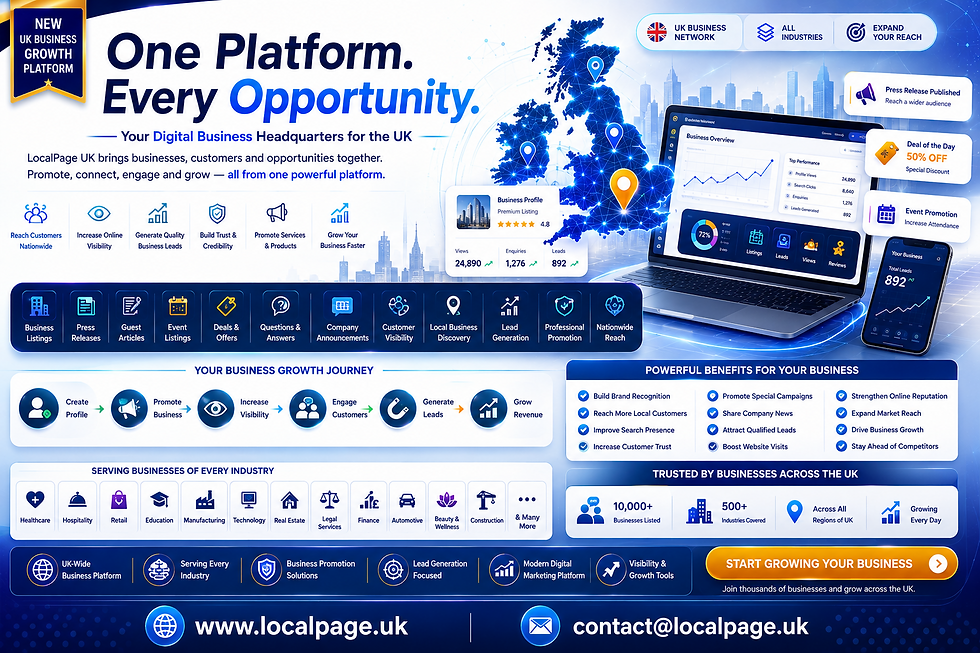
Upgrade from a Free Business Listing UK and position your brand inside the Local Page UK Business Directory for nationwide reach.
Not Ready for Sponsored? Start Free — Capture Leads Today
If you're exploring visibility options, begin with a Free Business Listing UK. Add your services, service areas, media and contact details. Even a free listing allows customers to discover and contact you directly.
The strategy is simple: List → Optimise → Upgrade → Dominate. Establish presence, capture initial enquiries, then scale visibility when you're ready for nationwide exposure.
Secure Sponsored Placement
Preferred Billing OptionQuarterlyYearlyGet Priority UK Visibility Now
Local Page UK — Structured Business Advertising UK. Built for Visibility. Designed for Growth.
📧 alex@localpage.uk | | 🌐 www.localpage.uk

Comments