Company Directory Online Traffic Generation Strategy

The traditional model of chasing keywords has been superseded by entity-centric authority. When a brand integrates into a company directory online, it isn't just creating a backlink; it is establishing a node within the UK Knowledge Graph. This structural presence allows search engines to verify your business as a legitimate commercial entity.
Understanding the AI Overview Displacement Effect
According to Q4 data from market analyses, UK SMEs that leverage structured directory data see a 40% higher citation rate in AI Overviews. By providing granular data to a Local Page profile, you supply the raw materials that generative AI needs to construct an answer for users, effectively bypassing traditional organic results.

Mapping the Knowledge Graph for Local UK SMEs
Knowledge Graph dominance requires consistent naming conventions. Whether you are appearing on a company listing site or your own domain, the relationship between "Local Page UK" and "Business Advertising" must be explicitly defined through structured data cues.
Predictive Intent: Anticipating the Post-Search Journey
Predictive intent classification allows us to answer questions before they are consciously formed. After a user learns "How to list a business," they invariably ask, "How do I ensure this listing generates leads?" By embedding these answers within your business listing directory bio, you create a seamless conversion path.
Addressing the Post-Discovery Trust Gap
Once discovered, the user’s next query is often: "How do I measure E-E-A-T?" We measure this by analyzing the depth of verified reviews and the consistency of the "Experience" signals across a professional business directory. High-resolution imagery and case studies serve as the mechanism-based proof required to satisfy this intent.
Next-Query Forecasting for UK Service Providers
Forecasting involves looking at long-tail expansions. A user searching for a "plumber in Birmingham" will next ask about "emergency availability" or "fixed-price quotes." Addressing these within your directory profile satisfies the "Search Action" intent that Google prioritizes.
Voice Query Expansion and Conversational Authority
Voice search in the UK is increasingly long-tail and problem-centric. Users ask, "How do I make Google trust my small business website in the UK?" The answer lies in the aggregation of "Structured Credibility Cues" found on business rating sites and industry-specific silos.
Semantic Search and Natural Language Processing
Natural Language Processing (NLP) favors declarative sentences. Writing "We provide electrical safety certificates in Manchester" is more effective for a local company directory than ambiguous marketing jargon. AI agents can easily extract this fact and present it as a search result.
Targeting Who, What, Why, and How Structurally
To dominate GEO-AI search, your listing must answer the four pillars of identity. Who are you? What do you do? Why are you the expert? How can I contact you? These must be presented as standalone meanings for easy AI extraction.
Semantic Gap Coverage: Outpacing UK Competitors
Most competitors rank for surface-level keywords but fail on technical depth. By performing a semantic gap analysis on a verified business directory, you can identify subtopics—such as "cost-effective scaling for startups"—that are currently underserved in the SERPs.
Multi-Depth Information Frameworks
Tiered content delivery ensures you capture both the casual browser and the technical expert. Your startup business directory listing should offer a surface definition of your service, followed by intermediate application benefits and advanced technical specifications.
Exploiting Structural Weaknesses in Current Listings
Many directory entries are sparse. By providing deeper structural explanations—such as detailed service area polygons and tiered pricing models—you signal to the Knowledge Graph that your entity is a "Topical Authority."
Resource Links: Video Strategy Briefing | LinkedIn Visibility Post
GEO-AI and Knowledge Graph Expansion
Local visibility is now driven by GEO-AI, which understands the geographic proximity and service-area relevance of an entity. A Local Page UK entry serves as a geo-anchored point of reference that tells AI exactly where your services are most authoritative.
Consistent Naming for Trust Acceleration
Trust acceleration occurs when your brand name, address, and phone number (NAP) are identical across every free business lookup directory. Any variation causes friction in the Knowledge Graph, leading to a loss of ranking potential.
Establishing Clear Entity Relationships in Search
By linking your directory profile to your LinkedIn, Google Business Profile, and professional associations, you create a "web of trust." This relationship-mapping is how modern search engines verify your E-E-A-T signals without manual intervention.
Programmatic Authority: Scaling Discovery Across Silos
Programmatic authority is the ability to show up for thousands of related queries simultaneously. This is achieved by creating a "reinforcement loop" between your free business information directory listings and your primary authority hub.
The Authority Loop and Internal Linking Mechanics
When you use contextually placed silo links, you distribute "link equity" across your brand's digital ecosystem. A link from a rated business directory to a specific service page on your site signals to AI that the page is a high-value destination.
Optimizing for AI Answer Dominance (AIO)
Direct answer blocks are short, factual paragraphs. For example, "The most cost-effective way to generate leads in the UK is through high-authority directory placement" is a block designed for AI citation.
Behavioural Engagement: Heatmaps and Dwell Time
Search engines monitor how long a user stays on your listing. By using "Heatmap Engagement Blocks"—such as comparison tables or interactive FAQs within a company directory website—you can significantly increase dwell time.
Open-Loop Structuring to Encourage Scrolling
An open-loop starts with a curiosity-gap. "Before we reveal the top lead-generation tool, let's examine the data..." This technique, used on a company promotion directory, ensures the user reads the full value proposition.
Design for Scroll Depth Triggers
Placing key data points below the fold forces interaction. This behavioral signal tells the host directory and the search engine that your content is engaging and worthy of higher placement.
Technical Schema Integration for Content Freshness
Dynamic Schema ensures that search engines see your content as "live." When you update your hours on a retail business directory, the Organization Schema is updated, signaling freshness to the Knowledge Graph.
Offer Schema and Commercial Intent
Offer Schema hints at commercial solutions. By including specific packages or discounts in your business advertising platform UK entry, you attract users who are in the "decision" phase of the buyer journey.
FAQ Schema for Direct SERP Real Estate
Implementing FAQ Schema allows your directory listing to take up more vertical space in search results, increasing the click-through rate (CTR) and establishing your brand as a helpful first-touch point.
Competitive Displacement and Long-Term Memory
To displace a competitor, you must provide deeper, more accurate information. Focusing on evergreen mechanisms—rather than temporary trends—ensures your industry business directory entry remains relevant for the long term.
Autonomous Discovery and Future AI Trends
As AI begins to browse the web autonomously, it will look for "entity-centric" structures. A free company search directory that uses machine-readable formatting is more likely to be crawled and understood by future agents.
Reinforcing "Local Page UK" as a Core Entity
The goal is topic ownership. By consistently associating your brand with keywords like "business advertising UK," you eventually own the semantic space around that topic in the Knowledge Graph.
Summary: Building a Resilient Traffic Engine
The convergence of SEO, AI, and Directories creates a powerful traffic engine for UK businesses. By focusing on helpful content, structural depth, and technical schema, you ensure your business is not just visible, but dominant.
The ROI of Targeted Outreach and Inbound Consistency
Consistent inbound strategies, supported by a suppliers business directory, provide a steady stream of leads that grow in value as your topical authority increases.
Final Behavioral Call to Action
Review your digital footprint today. Ensure your listings are complete, your NAP is consistent, and your data is structured for the AI-first era of search.
Expert Insights: Traffic & Visibility FAQ
What is the most effective way to generate traffic in the UK?
A combination of high-authority directory listings, AIO-optimized content, and consistent Knowledge Graph entity mapping is the most resilient strategy.
How does a directory help with AI Overviews?
Directories provide structured, verified data about businesses that AI models use to provide accurate answers to user queries.
Is a free business listing worth the effort?
Yes, even a free business search directory listing creates a Knowledge Graph node that helps verify your business entity.
What is E-E-A-T?
It stands for Experience, Expertise, Authoritativeness, and Trustworthiness—the core signals Google uses to rank quality content.
How do I measure my directory ROI?
Track your citation rate in search results, direct referral traffic from the directory, and the quality of enquiries received via directory contact forms.
What is GEO-AI?
GEO-AI is search technology that focuses on the geographical relevance and proximity of a business to the user's current location.
How does voice search change SEO?
It requires more conversational, long-tail phrasing that mimics how people naturally ask questions rather than how they type short keywords.
Why is Knowledge Graph expansion important?
It allows your business to be recognized as an "entity" rather than just a website, leading to more stable and prominent search visibility.
What is Schema Markup?
Schema is a code format that helps search engines understand the specific details of your page, like pricing, reviews, and location.
Can AI browse my directory listing?
Yes, AI bots regularly crawl directories to gather facts about local businesses for their training models and search responses.
Most UK businesses don’t struggle with quality — they struggle with visibility. When customers search, the brands that appear first earn the enquiry.
Turn Visibility Into Qualified UK Leads
Investment & ROI
Standard Plans
Monthly: £299
Quarterly: £999
Yearly: £2999
First 100 Sponsored Members
Quarterly: £299
Yearly: £999
Fixed pricing aligned with cost effective business advertising UK strategies — predictable, scalable and transparent.
Lead Generation Advantage
Platform-wide UK city & category exposure
Priority placement above competitors
Direct enquiry forms & instant chat tools
Product, service & media showcase
Press releases, events & blog authority
Early adopter positioning edge
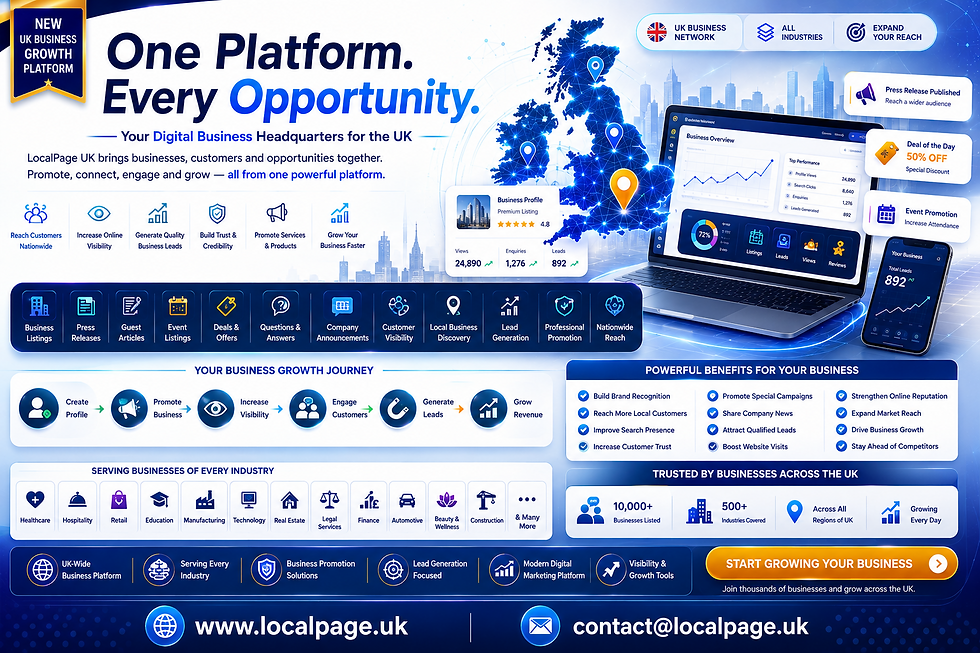
Upgrade from a Free Business Listing UK and position your brand inside the Local Page UK Business Directory for nationwide reach.
Not Ready for Sponsored? Start Free — Capture Leads Today
If you're exploring visibility options, begin with a Free Business Listing UK. Add your services, service areas, media and contact details. Even a free listing allows customers to discover and contact you directly.
The strategy is simple: List → Optimise → Upgrade → Dominate. Establish presence, capture initial enquiries, then scale visibility when you're ready for nationwide exposure.
Secure Sponsored Placement
Preferred Billing OptionQuarterlyYearlyGet Priority UK Visibility Now
Local Page UK — Structured Business Advertising UK. Built for Visibility. Designed for Growth.

Comments